How to Play Truth or Dare — The Complete Rules & Guide

Sit in a circle. Take turns. Each player chooses Truth — answer a question honestly — or Dare — complete a challenge. Refuse both and you face a forfeit decided by the group. That is the whole game. But the difference between a session that ends in five minutes and one people talk about for years? That comes down to the questions you ask, how you set the tone, and the specific choices covered in this guide.
Truth or Dare has survived for over two thousand years not because the rules are complex but because they are elegantly simple. Two words, one choice, no escape. What makes the difference between a game that goes flat after three rounds and one that becomes one of the better evenings a group has had together is almost never the rules. It is everything around the rules.
This guide covers the basic setup, every meaningful variation, and how to adapt the game for different ages and group sizes. For an exhaustive look at handling edge cases, disputes, and penalties, check out our companion piece on the official Truth or Dare rules. Whether you are running a game for ten-year-olds at a birthday party or setting up a late-night session with close friends, you will find what you need here.
You can also play the free online version at truthordarequiz.com which handles the questions automatically across 9 categories and 4 spice levels, so you can focus on the game rather than managing a list.
- What You Need to Play
- The Complete Official Rules
- How to Start the Game — Step by Step
- Truth Rules — How to Ask and Answer
- Dare Rules — What Counts and What Doesn't
- Forfeits and Refusing
- Age Variations — Kids, Teens, Adults
- Popular Game Variations
- Playing Online or Over Video Call
- What Makes a Game Actually Good
- Frequently Asked Questions
🎯 What You Need to Play
Truth or Dare requires almost nothing. That is a large part of why it has lasted so long.
Minimum 2, ideal 4 to 8, maximum around 10 before turns become too infrequent. For larger gatherings, split into smaller circles rather than playing as one oversized group.
Anywhere you can sit in a rough circle so everyone can see each other. A living room floor, a circle of chairs, a garden, a campfire — the game requires only enough space for the group to feel like a shared environment.
Either prepare a list in advance, use an online game like ours that serves questions automatically, or generate them on the spot. Having some prepared questions prevents the game from losing momentum when someone goes blank.
A typical session runs 30 to 90 minutes. With 6 players and 3 to 4 questions each, you are looking at roughly 45 minutes. There is no set endpoint — the game ends when the group agrees it does.
📜 The Complete Official Rules
These are the rules most groups use and the ones that produce the best games. There is no single governing body for Truth or Dare, but the version below represents the widely accepted standard that has been played consistently for decades.
On your turn, you must choose Truth or Dare. You cannot sit out, skip your turn, or refuse to engage without accepting a forfeit. Choosing neither is not a valid option.
If you choose Truth, you must answer the question honestly. A vague, deflective, or obviously false answer counts as a refusal and triggers a forfeit. The group decides whether an answer was genuine enough.
If you choose Dare, you must complete the challenge. Partial completion or deliberate underperformance counts as a refusal. You may ask for a different dare once per turn if a dare is genuinely unsafe, but the group must agree.
If you refuse both Truth and Dare, the group decides your forfeit. A forfeit is typically more demanding than the original option you avoided. This rule is what keeps the game moving.
Dares must be physically safe and emotionally reasonable for everyone in the group. A dare that could cause genuine harm, embarrassment beyond what the person is comfortable with, or legal consequences is off-limits. The game is for fun, not coercion.
Turns go around the circle in a set order, usually clockwise. The first player is determined by any agreed method — youngest first, oldest first, whoever volunteers, or a spin of a bottle. Turns do not skip people without reason.
In standard play, the same player is not targeted with a question or dare twice in a row. If using a bottle spin format where one person asks and the other is chosen by spin, the spinner and the person chosen swap roles for the next round.
🚀 How to Start the Game — Step by Step
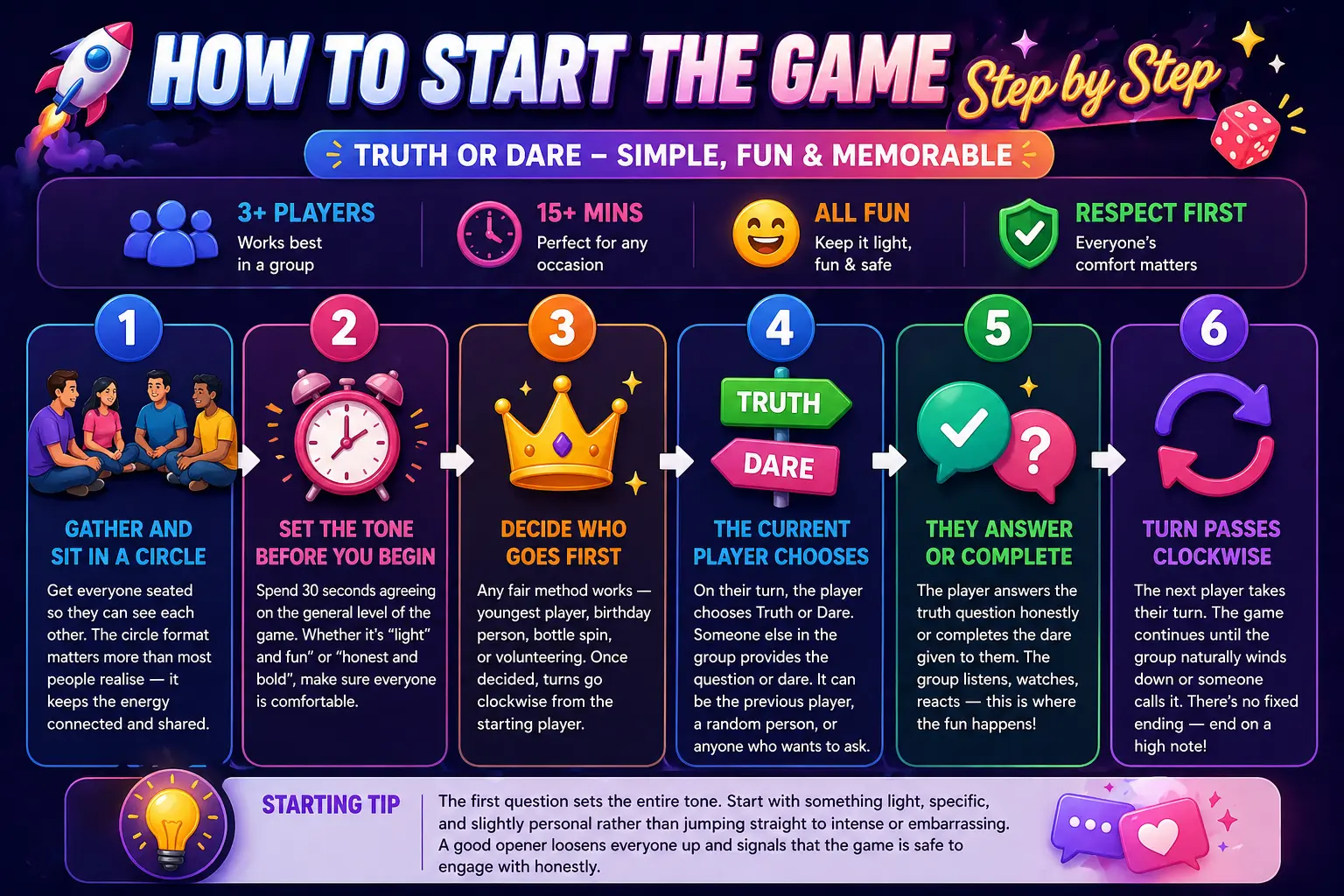
Gather and sit in a circle
Get everyone seated so they can see each other. The circle format matters more than most people realise. When everyone can make eye contact, the energy of the game is shared across the whole group rather than directed at just one person at a time.
Set the tone before you begin
Spend 30 seconds agreeing on the general level of the game. A simple "we're keeping this fun and light" or "we're going for honest and bold tonight" is enough. This prevents mismatched expectations and makes everyone feel safe before the first question lands.
Decide who goes first
Any fair method works. Common choices include the youngest person, the person whose birthday is nearest, whoever volunteers, or a bottle spin. Once decided, turns go clockwise from the starting player.
The current player chooses
The player whose turn it is announces their choice: Truth or Dare. Someone else in the group — either the previous player, a randomly chosen player, or anyone who wants to ask — then provides the question or dare.
They answer or complete
The player answers the truth question honestly or completes the dare. The group listens, watches, reacts. This is the moment the game is built around — give it space. Do not rush to the next player.
Turn passes clockwise
The next player in the circle takes their turn. The game continues until the group naturally winds down or someone calls it. There is no fixed endpoint — ending on a high note is better than playing until energy drops.
The first question of the game sets the entire tone. Start with something light, specific, and slightly personal rather than jumping straight to intense or embarrassing. A good opener loosens everyone up and signals that the game is safe to engage with honestly.
🤍 Truth Rules — How to Ask and Answer
The truth half of the game is where most of the memorable moments come from. But it only works when both the asking and the answering are done well.
What makes a good truth question?
The best truth questions are specific and personal without being invasive. They ask about something real — a feeling, a memory, an opinion, a preference — rather than something abstract. "What is your biggest fear?" is weaker than "What is one fear you have that would surprise everyone in this room?" The more specific the question, the more specific and interesting the answer.
How honest does the answer need to be?
Completely. That is what the word means in this context. A vague answer like "I don't know" or an obviously deflective response should be called out by the group and treated as a refusal. The social contract of the game is that Truth questions get truthful answers — that is what makes them worth asking in the first place.
Can you ask follow-up questions?
In most versions, yes — but the person answering only has to respond to the original question. Follow-up questions are an option, not a requirement. Many of the best conversations in truth or dare happen in the follow-ups, so it is worth allowing them when the group is engaged in what someone has said.
What if the question is too personal?
Many groups allow one pass per game — a player can decline a single question without accepting a forfeit. This works especially well with younger players or in groups where some people know each other less well. Announcing this rule at the start makes everyone feel comfortable enough to engage more fully with the questions they do answer.
🔥 Dare Rules — What Counts and What Doesn't
Dares are where the laughter lives. They are also where the most problems arise when a game goes wrong. The difference is almost always in how dares are framed and what boundaries the group has implicitly agreed to.
What makes a good dare?
A good dare creates a shared moment. It might be funny, slightly embarrassing, physically energetic, or genuinely creative. The best dares generate a reaction from the whole group — not just discomfort in one person. A dare that makes everyone laugh including the person doing it is a great dare. A dare that makes one person miserable while everyone else watches is not.
The safety rule
Any dare that could cause physical harm, genuine emotional distress, legal consequences, or damage to property is not acceptable regardless of context. This applies in every group and with every age range. The game is not worth any of those outcomes. If someone sets a dare that crosses this line, the game leader or any member of the group should call it out immediately.
Can you negotiate a dare?
In most versions, you get one opportunity to ask for a different dare if the original one is genuinely not something you are able or willing to do. The group has final say on whether a replacement dare is granted. If you refuse the replacement as well, you accept the forfeit.
Silly physical challenges. Sending a specific message to someone. Performing for the group. Sharing something from your phone. Doing an impression. Saying something honest to someone present. Attempting something genuinely difficult but safe.
Anything physically dangerous. Dares requiring contact between players without clear consent. Public behaviour that could cause genuine embarrassment outside the group. Dares involving alcohol for underage players. Anything that could have lasting negative consequences for the person doing it.
⚡ Forfeits and Refusing
The forfeit system is what gives the game structure. Without it, players would simply decline anything they found uncomfortable and the game would not function. The forfeit creates a real cost for refusing, which makes the choice between truth and dare feel genuinely meaningful.
How should forfeits work?
A forfeit should be more demanding than whatever was refused. If someone refuses a moderately awkward truth question, an appropriate forfeit might be doing something more embarrassing than the question would have been. The forfeit is not supposed to be punitive or harmful — it is supposed to be an incentive to engage with the game rather than opt out of it.
Classic forfeit options
- Sit out for one full round and watch without participating
- Accept the next dare without any right to refuse or negotiate
- Do a physical challenge chosen entirely by the group
- Let the group post one thing on your social media
- Answer the original question anyway, regardless of wanting to refuse it
- Do an impression of everyone in the room one by one
The best forfeit system is one where refusing never feels like the easier option. If your forfeits are too mild, people will refuse constantly. If they are too harsh, the atmosphere becomes coercive. Aim for forfeits that are notably more uncomfortable than the thing being refused — but still within the same spirit of fun as the rest of the game.
🧒 Age Variations — Kids, Teens, and Adults
One of Truth or Dare's great strengths is that it scales across ages. The core mechanic is identical at every age level. What changes is the nature of the questions and dares, the intensity of the game, and the social function it serves.
| Age Group | Question Style | Dare Style | Key Principle |
|---|---|---|---|
| Ages 6 to 10 | Imaginative and silly — favourite things, superpowers, funny hypotheticals | Physical and comedic — impressions, silly walks, sound effects | Maximum silliness, zero personal pressure |
| Ages 11 to 13 | Light personal questions — favourite memories, mild preferences, funny stories | Creative and performative — skits, challenges, group dares | Fun first, avoid anything that singles anyone out uncomfortably |
| Ages 14 to 17 | Genuine personal questions — opinions, mild feelings, real experiences | Social and slightly bold — sending messages, sharing things, doing impressions | Keep spice level appropriate; avoid anything a parent would object to |
| Adults | Full range from flirty and funny to deep and honest depending on group | Full range from silly to bold — adapted to context and comfort level | Match the energy to the relationship and the setting |
For age-specific question lists, our kids truth or dare guide covers ages 6 to 12 with 200+ safe and fun questions, while the teen edition has 200+ questions built for ages 13 to 17.
🔄 Popular Game Variations
The basic rules are just the starting point. These variations are played widely and each one changes the dynamic of the game in a meaningful way.
🍾 Bottle Spin Version
Players sit in a circle with a bottle in the centre. The current player spins the bottle. Whoever it points to must choose truth or dare, and the spinner sets the question or dare. When complete, the person who just answered becomes the spinner. This version removes the clockwise order and adds an element of randomness to who gets targeted.
🎯 Category Version
Before the game, the group agrees on categories — Couples, Friends, Wild, Safe. Each player draws from a specific category based on the mood they want. This version works especially well with larger groups where different people have different comfort levels, as each person can opt into their preferred intensity without the whole group having to agree on one level.
⏱ Timed Dare Version
Dares must be completed within a set time limit — usually 60 seconds. If the player fails to complete the dare within the time, they automatically face the forfeit. This adds urgency and comedy to physical dares and prevents the game from slowing down during the dare rounds.
🔒 No Repeat Version
Once a truth question has been asked, it cannot be used again. Once a dare has been completed, it cannot be assigned to another player. This forces the group to be creative throughout the session and prevents the game from falling into a predictable loop of the same five questions.
📱 Online Version
Instead of generating questions on the spot, a dedicated game like truthordarequiz.com serves questions automatically. This removes the pressure of thinking of good questions in real time and ensures a consistent quality and variety across the session. Ideal for groups that want to focus entirely on playing rather than managing the game.
🌶️ Spice Level Version
The group agrees on a spice level at the start — Soft, Flirty, Bold, or Extreme — and all questions and dares stay within that level. Players can also choose their own level individually, so some players are on Soft while others go Bold. This variation works well for mixed groups where comfort levels vary significantly.
▶ Play Truth or Dare Right Now — Free
2000+ questions across 9 categories. 4 spice levels. Multi-player turn tracking. Works on any device. No setup, no signup, no list to manage.
▶ Start Playing Free📱 Playing Online or Over a Video Call
Truth or Dare works just as well remotely as it does in person. The format is naturally suited to digital play because the truth questions require only voice and honesty, and dares can be adapted for anything each player can do on their own side of a screen.
Playing over a video call
Each player joins the same video call on their own device. Take turns exactly as you would in person — the current player announces their choice, someone sets the question or dare, and the player responds on camera. For dares, choose challenges that work remotely: sending a voice note, sharing something from your phone, showing your surroundings on camera, sending a message to someone while the group watches, or doing something physical that everyone can see on screen.
Using an online game
The easiest approach for remote play is opening the free game at truthordarequiz.com on each player's device simultaneously. Questions appear on everyone's screen at the same time, every dare is adapted for remote play, and the game handles turn tracking automatically. For long distance couples specifically, our long distance couples guide has 200+ questions designed specifically for video call play.
The biggest challenge with remote Truth or Dare is maintaining energy across a screen. Combat this by keeping rounds shorter than you would in person — 3 to 4 questions each rather than 6 to 8. Start with the lighter questions immediately and do not warm up too slowly. Remote attention spans for games are shorter than in-person ones, so the questions need to be more interesting from the beginning.
🏆 What Makes a Game Actually Good
Most people have played a version of Truth or Dare that felt flat. Questions that nobody really answered honestly. Dares that nobody actually completed. Turns that dragged. A session that ended because people got bored rather than because the energy was still high and everyone just decided to stop. Here is what separates that kind of game from a genuinely memorable one.
The first question sets everything
The opening question of a session calibrates every question that follows. Start with something that is warm, slightly personal, and easy enough that the first person to answer can do so comfortably. This establishes a tone of honesty without pressure, which makes every subsequent question land more genuinely. Starting with something too heavy or too scandalous before the group has warmed up almost always kills the game's energy in the first five minutes.
Do not rush past good answers
The instinct in truth or dare is to move quickly through turns. Resist this. When someone gives a genuinely interesting or honest answer, let it breathe. Ask a follow-up if one feels natural. Let the group react. Some of the best moments in a truth or dare session happen not in the question itself but in the conversation that opens up around the answer. The list is a starting point, not a script.
Mix truth and dare deliberately
A session that is all truth questions becomes an interrogation. A session that is all dares becomes a performance. The best games alternate intentionally — two or three truths, a dare to reset the energy, back to truths, another dare. Use dares to lighten the mood after something emotional, and truth questions to deepen the mood after a particularly silly dare has everyone laughing. Treat the game as a rhythm you are conducting, not just a list you are working through.
Be the example
Whoever goes first — whether that is the game leader or simply the first player — sets the standard for honesty and commitment for the entire session. If the first person to answer a truth gives a real, specific, honest answer rather than a surface one, everyone else will raise their level to match. If the first dare is completed with full commitment and good humour, the dares that follow will be taken more seriously. Go first whenever you can and go all in on your answer.
Know when to end
The best time to end a game is when the energy is still good but starting to plateau. Ending on a high means the last thing everyone remembers is how good the game was. Continuing past the point where the session is still alive means the last thing they remember is the game going flat. One more good question after the peak, then call it. The group will remember it better for it.
❓ Frequently Asked Questions
📚 Question Lists for Every Group
Now that you know the rules, find the right questions for your specific group and situation.

Founder & Digital Marketer with 4.5 years of experience. As a Game Enthusiast, Ajay curates interactive experiences that foster genuine connection through play. Find more at truthordarequiz.com.